Two and a Half Hours from Sydney, and Everyone's Speaking French. New Caledonia, Noumea, Is Closer Than You Think.

Updated: Jul 24
Two and a half hours out of Sydney, everyone around me was speaking French. I was hooked before we'd even landed.
In a hurry? Here's the short version
New Caledonia is a slice of France in the South Pacific, two and a half hours from Sydney. The capital, Noumea, is small, walkable, French, and a lot easier than people give it credit for.
I went as one of six travel agents hosted by New Caledonia Tourism, so I saw a lot in a short time.
Here's what I learned: the locals are warm, the food is exceptional, you can swim in a lagoon right in the middle of the city, and it costs about the same as a trip to anywhere else in Australia.
The old reputation for being stuffy and expensive is a hangover from the 1990s. It simply isn't true anymore.
If you've been telling yourself you have to fly 23 hours to Europe for French food, French wine and a genuine sense of being somewhere else, you don't.
It's right here, a short hop across the Coral Sea.
This is a long one, so grab a cuppa.
I've covered the hotels, the food, the day trips, the safety question every solo woman asks me, and the three myths I'd love to put to bed for good.
First impressions: I thought I'd boarded the wrong plane
I knew within minutes of boarding that this was going to feel different.
Everyone around me was speaking French.
The crew, the passengers, the announcements. It felt like I was flying to Paris, not to a Pacific island two and a half hours north of Sydney.
The flight itself was easy. Clean plane, lovely crew, nothing to report. On par with a domestic hop.
And then we landed, and the thing that has stayed with me wasn't the palm trees or the heat.
It was the customs officials.
Big, burly blokes, hugging their friends, their families, their cousins as people came through the gate. Smiling. Genuinely pleased to see the people they knew.
I have been through a lot of airports in 30+ years in this industry, and I can tell you that warmth at customs is a rare thing.
Two and a half hours from home, and I already felt like I'd arrived somewhere else entirely.
Where exactly is New Caledonia, and what is it?
New Caledonia is a French territory in the South Pacific, east of Australia. The main island is Grande Terre, and the capital, Noumea, sits on its south-western tip.
It's home to about 271,000 people. The official tourism figures break it down as roughly 44% Melanesian (the Kanak people, the Indigenous population), 34% European (locally called Caldoches), with significant Wallisian, Tahitian, Indonesian and Vietnamese communities making up the rest.
More than a third of everyone lives in Noumea.
French is the official language, though it coexists with more than forty Melanesian dialects. The currency is the Pacific Franc.
What this all means for you as a traveller is simple: it's France, but Melanesian, but Pacific, all at once.
And it's close.
Let's bust three myths while we're here
I got a lot of questions about New Caledonia when I was flashing this trip on 'my socials', and most of them are built on ideas that are years out of date. So let me tackle the big three head-on.
Myth one: "The locals are rude and aloof"
I heard this before I went, and I want to put it firmly to bed.
I did not experience a single moment of rudeness. Not one. Every interaction was smiles and politeness, whether I was stumbling through my very ordinary French or not.
A lot of the service staff are Kanak, and warmth seems to be woven right through the culture.
The French locals I met were bending over backwards too.
And there's a practical reason for it: tourism matters here.
New Caledonia's economy runs on nickel first, and tourism is right up there as a major earner. They understand that travellers are important, and I think you feel that in every exchange.
If you want to win people over even faster, do what I did and open with a few words of bad French. It's not about getting it right. It's about showing you've made the effort.
Myth two: "It's just another resort destination, and not even a good one"
Here's where I want to be honest with you, because that's the only way I know how to write.
No, you will not find the enormous mega-resorts you get in Fiji. If that's the specific thing you're chasing, manage your expectations.
But here's the reframe. In Fiji or Thailand, those big resorts are often plonked in the middle of nowhere, and the resort is all you get. You fly in, you stay put, you fly home.
Noumea is different. It's a small, culturally rich capital with beautiful places to stay right on the city edge.
You can stay in a resort or in a well-priced apartment, and either way you've got a lagoon on your doorstep, tropical fish you can see from the shallows, genuine restaurants, real French food along the main drag, and proper day trips out into the wild.
You get a place, not a bubble. For me, that's not a compromise. That's the whole point.
Myth three: "It's prohibitively expensive"
This is the big one, and I think it's the most out of date.
I did not find New Caledonia expensive.
Eating out, away from the hotel restaurants, was on par with Australia, sometimes a touch cheaper. Hotel restaurants cost more, as they do everywhere. Local restaurants cost less.
The accommodation, in particular, is exceptional value, and a lot of the rooms come with kitchens.
Those kitchens are a feature, not a fallback. They send you straight to the supermarché, which is one of the great joys of the place. More on that below.
The restaurants also do the very French thing of a set menu, a plat du jour or menu du jour, where you get two courses and a glass of wine or a beer for a fixed price.
It's good value and very civilised.
The "expensive" reputation, I suspect, is a hangover from the 1990s, back when a lot of us in the travel industry first formed our impressions. It has changed. Whether the old guard has noticed is another matter.
Swimming in a lagoon in the middle of the city
This was the moment Noumea won me over.
There's a lagoon right in the middle of the city. Not a half-hour drive away. In the middle of it.
The water is calm and clear. I had little fish swimming around my ankles before I'd even committed to getting in past my knees. Birds overhead. Kitesurfers off to one side with their own launch area, because the wind here is made for it.
There are proper metal shark nets, because yes, they've had the odd shark over the years.
As an Australian, that doesn't faze me in the slightest. It's standard context for us.
There's a lifeguard on duty where Le Meridien and Chateau Royal sit, and it's safe for kids and grandkids to swim. You can see sea life with just your legs in the water.
If you've ever tried to find a swimmable spot in the middle of a city, you'll know how rare this is. It's the thing I'd tell anyone to do first.
A word of safety, and it's the same as home: swim where the nets are.
The food, and why the cream tastes different
I need a whole section for the food, because it genuinely surprised me.
Let me start with the prawns. They're sweet. Properly sweet, in a way that's different from home. I don't fully know why, but I noticed it every time.
The salads are beautiful. Most restaurants do a Caesar, and you can have it with prawns, and it's divine. I had it more than once and would happily have it again.
Then there's a combination I fell for completely: goat cheese with honey. I'm not sure if it's a French thing, but it turns up everywhere, on pizza and in salads, often with a beautiful thin-sliced aged Serrano ham alongside.
The mix of the soft cheese, the honey and the salt of Serrano ham is just lovely.
The Tahitian salad is worth seeking out too. Coconut-based dressing, raw white fish, and despite all that dressing it isn't sweet.
The specialties across the board are beef, seafood and, of course, French.
And the desserts. If you have a sweet tooth, you're in trouble here, in the best way. The classics like crème brûlée are everywhere, but here's the thing I keep coming back to: the cream tastes different. Better. Richer.
The ice cream too, simple flavours done exquisitely.
I have a theory about the cream, and there's something to it. New Caledonia draws a lot of its dairy from France and New Zealand, and French dairy, with its particular breeds and standards, genuinely does produce richer, higher-fat cream.
So it's not your imagination. The cream really is different.
Then there are the cheeses, the charcuterie, the French wines. Beautiful rosé, reds from Bordeaux and Burgundy, Chardonnay, blanc de blancs Champagne.
And the lovely French habit of giving you a little something on the side when you order a drink at a bar.
A wine tasting I won't forget
One of the highlights was a wine, cheese and meat tasting at Le Chai de l'Hippodrome, an arty, characterful wine bar in the Anse Vata area, opposite the racecourse it's named after.
We worked our way through gorgeous French wines and shared charcuterie boards loaded with salami, ham and beautiful cheese.
The vibe was cool and the wine list serious. If you love your French reds, this is your spot.
The market and the supermarché
On the city tour we visited the market at Port Moselle, on Moselle Bay.
Fresh fish, produce, French pastries, croque-monsieur, good coffee, and a handicraft section. It's not huge, but it's a real find.
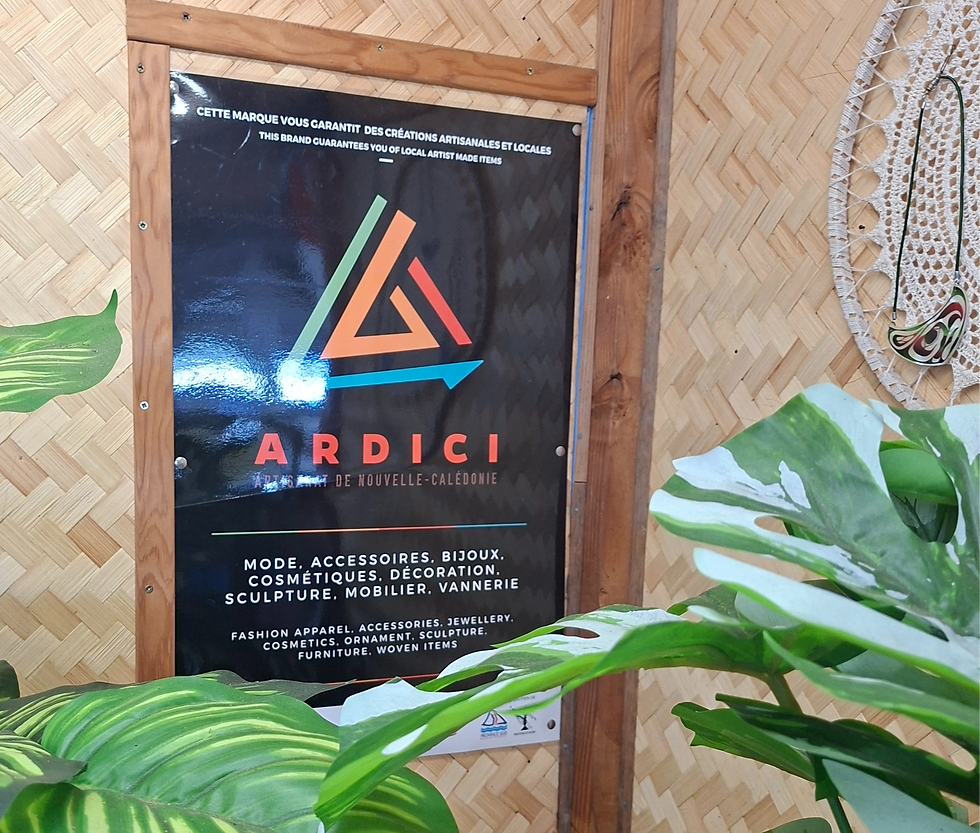
One thing I learned from a stallholder who makes his own jewellery: look for the official accreditation mark that tells you a piece is genuinely made in New Caledonia. If you want a real local craft rather than an import, that's the sign to look for.
And then the supermarkets. I know, I know. But a French supermarket is one of life's great pleasures, and Noumea has several: Carrefour, Champion, Casino, Géant.
The cheese aisle alone is worth the trip, and the French wine is properly good value.
With so many rooms here coming with kitchens, plan a couple of nights of simple eating in. After all that rich restaurant food, your body will thank you, and your wallet will too.
Kanak culture and the Tjibaou Cultural Centre
If you do one cultural thing in Noumea, make it the Tjibaou Cultural Centre.
It was designed by Renzo Piano, the architect behind the Centre Georges Pompidou in Paris, and it's New Caledonia's most striking piece of architecture.
The buildings are tall timber and steel structures inspired by traditional Kanak design, deliberately left looking a little unfinished, as a reminder that Kanak culture is living and still evolving.
An avenue of columnar pines connects them into three "villages," each with its own purpose.
It opened in 1998 and is named after Jean-Marie Tjibaou, a leader who dreamed of a centre that would hold the linguistic and artistic heritage of the Kanak people.
It collects and showcases Kanak art, music and history, and it gave me real context for the island's history.
I was taken with the Kanak woodcarvings. The carving tradition here is remarkable, and standing among the work and the soaring buildings, you feel the depth of a culture that's 83 million years of evolution in the landscape around it and thousands of years of human story within it.
It's the kind of place that shifts how you see the whole destination. It's not a beach with a hotel attached. It's somewhere with real cultural weight.
Day trips: the islands, and the bird that barks
We'd planned to visit the Isle of Pines, which is meant to be extraordinary. The weather had other ideas. Severe weather cancelled every boat and flight to the islands, not just on our day but again when I was back at the airport later in the trip.
You can't argue with the weather, and I'll come back to what that taught me. But it led us to two of my favourite days.
Amédée Island
Instead of the Isle of Pines, we went to Amédée Island, also known as Phare Amédée after its lighthouse. It's about forty minutes by boat from Noumea and one of the most popular day trips going.
You can snorkel straight off the beach.
The first thing I saw when I put my face in the water was colourful fish swimming through the sea grass. The grass sits along the edge of the coral, and as you keep swimming out to meet the coral, you find all sorts of little fish hiding among it.
We spotted turtles from the glass-bottom boat, and black crabs scuttling across the black rocks. They look a touch alarming. They're only crabs.
The food on the day trip was lovely and handmade, with a bit of entertainment thrown in.
And here's a fact I loved: the lighthouse was built in 1861 in the same Paris workshop that built the Eiffel Tower, then shipped out in pieces and reassembled on the island.
The French thread runs through everything here, even the lighthouses.
One practical tip that matters: bring coral shoes or reef boots. You'll want them for getting in and out over the coral.
Blue River Provincial Park and the cagou
About 45 minutes out of Noumea is the Blue River Provincial Park, and it was one of the most surprising places I've been.
The landscape is unlike anything I've seen. The earth is a deep desert orange, the colour coming from the iron and nickel in the soil, and from old land clearing in the early days of settlement when people came looking for nickel.
Against that orange sits lush green rainforest, some of it old growth, with trees around a thousand years old.
The contrast between the orange earth and the green forest was striking.
Almost otherworldly.
I've seen rainforest, and I've seen desert, but I'd never seen the two colours sitting side by side like that. It stopped me in my tracks.
You can canoe, you can swim, and the walking is fairly easy. There's a clear line between the cleared land, now protected and regenerating, and the ancient old-growth forest.
And then there's the cagou.
The cagou is the emblem of New Caledonia, and it's a genuinely special bird to see. It can't fly. And here's its most endearing quirk: it doesn't tweet, it barks, like a dog.
It's the sole surviving member of its entire genus, found nowhere else on earth, and it was once almost extinct. Thanks to careful protection, the park now holds the territory's largest population, around 900 birds.
We were extraordinarily lucky. We saw them scuttling through the shrub all day, whole families of them, little ones included.
For a bird that was nearly lost, that felt like a real privilege. They're most active at dawn and dusk, so time your walk if you want the best chance.
Where to stay: a solo traveller's hotel guide
We inspected a good spread of hotels, from overwater bungalows to neat little three-stars in the heart of the action. Here's my honest take, with solo travellers especially in mind.
For an overwater bungalow without flying to Tahiti: DoubleTree by Hilton, Îlot Maître
You don't have to go to the Maldives. You don't have to go to Tahiti. There are overwater bungalows right here, a short hop from the capital, on Îlot Maître.
The bungalows are spacious, and you can walk straight off your deck into the water. When I was there, the sea life was abundant, fish of every colour and size, and big sea turtles. If the overwater experience is on your list, this is a lovely, close way to tick it off.
For space and a kitchen: Hilton Noumea
The Hilton is more apartments than hotel rooms, with proper kitchens, good-sized fridges and real cooking facilities. Spacious and practical, especially if you want to do some of your own cooking with ingredients from the market and the supermarché.
For four and five-star comfort: Noumea Resort & Spa and Château Royal
These two sit side by side on the lagoon at the city's edge, and they're the pick of the fancy options.
Noumea Resort & Spa is an older hotel with a grand, traditional five-star entrance. The rooms are spacious, and some have kitchens. There are lovely indoor and outdoor spaces and bar areas, and the on-site outdoor restaurant has beautiful views and ambience.
The pool at Noumea Resort & Spa was the best I saw at any of the hotels, large and lovely.
Château Royal is right next door, also on the lagoon.
The balconies come with a table and chairs, which sounds like a small thing until you realise it means you can pop down to the supermarché, grab some cheese and charcuterie, pick up wine from the on-site Le Cave, and have your own little feast looking out over the lagoon.
These rooms also come with a kitchen.
There's also a water spa, very European in style, with a whole variety of jets.
My favourite was the hard jet for the feet. I went in for what I thought would be a quick dip and came out a solid hour later, thoroughly wrinkly and thoroughly relaxed. (Worth knowing: the spa treatments are closed on Sundays, as many things are here.)
The real gift of these two is the location. You can walk the waterfront and choose between the lagoon or the pool whenever the mood takes you.
For comfort and a sense of being properly looked after, I'd happily stay at either as a solo traveller.
For walkability and a local vibe: Gondwana Hotel and Hotel Beaurivage
If being able to walk out the door to dinner and a wander matters to you, and it should, these two three-star hotels are the ones I'd point you to.
The Gondwana is right in the city, with a busy, social, local vibe and lots of shared spaces.
Great for solo travellers who want a bit of buzz around them.
At Gondwana, they make a real effort to be eco-friendly, and here's the touch I loved: local Kanak artists have painted murals in every room.
You can feel how much these people care about their travellers, and the reviews bear it out. It felt almost like a family.
While we were there we met August, the gardener. August is a big chief of one of the villages (they have big chiefs and little chiefs), and he gives talks and workshops on Indigenous medicines.
He's even been known to help sunburnt travellers with local remedies. That's the Gondwana for you. You arrive as a guest and a big chief tends the garden out the front.
Hotel Beaurivage is in the funky, popular Baie des Citrons area (the locals call it Lemon Bay), right across the road from the lagoon swimming spot, with a cool restaurant downstairs that's open most of the day until about 10pm.
If I were travelling solo, this is where I'd stay. The restaurant is the kind of place I'd feel completely comfortable eating alone, sitting right on the streetscape, watching the world go by.
When I visited, they were converting a room into an accessible room, which is genuinely good to see.
Is Noumea safe for solo women? The honest answer
This is the question I'm asked more than any other since I went. Many of my friends have memories of going to Noumea on school French-speaking trips back in the 70s and 80s, so let me answer it plainly.
I felt safe. Including at night.
That said, it's a city, and like any city there are areas to be sensible in.
My simple advice is to check in with your hotel before you head out for a walk. They'll tell you where's good and where to give a miss.
That's true of anywhere in the world and it's true here.
On accessibility and mobility: some of the streets can be a challenge if you have mobility issues. Some hotels have accessible rooms, and as I mentioned, Beaurivage was adding one when I visited.
If access matters for your trip, it's worth asking specifically when you book.
And one more thing that makes Noumea lovely for solo travellers: it's small. It's not a vast, anonymous city.
If you go, you will meet local people.
I found it genuinely easy. You end up swimming in the lagoon alongside the locals, and there's something about that, sharing the everyday with the people who live there, that makes you feel less like a tourist and more like you belong for a while.
A note on the weather, and why flexibility matters more than ever
I didn't get to the Isle of Pines. The weather closed it down, boats and flights both, and not just once.
I'm not telling you this to put you off. I'm telling you because it's the reality, and because it taught me something worth passing on.
As our weather gets less predictable, build a bit of flexibility into your island plans. If you're heading out to the Isle of Pines or any of the islands, it can be worth paying a little extra for flexible flights.
And bear in mind it can work the other way too: you could find yourself stuck on an island waiting for the weather to clear.
Talk to your travel agent, plan for a buffer, and don't pin your whole trip to one fixed island day.
The upside? Our Plan B days, Amédée and Blue River, turned out to be among the best of the whole trip.
Sometimes the weather does you a favour.
What I'd tell a friend over coffee or a glass of french red

If you've read this far, here's the short of it.
New Caledonia is a Melanesian culture crossed with a bit of France, two and a half hours from Sydney.
It's warm, it's welcoming, the food is wonderful, the wine flows, and you can swim in a lagoon in the middle of the city before breakfast.
It's not the Fiji mega-resort experience and it was never trying to be. It's something better: a real place, with real culture, real food and real people, that happens to sit on your doorstep.
The old stories about it being rude and expensive belong in the 1990s. Leave them there.
People tell me all the time they're looking for somewhere different. Somewhere that feels like a proper getaway without the 23-hour flight. This is genuinely it.
Happy travels,
Bron
I visited New Caledonia as one of six travel agents hosted by New Caledonia Tourism. As always, the opinions, the observations and the wrinkly spa fingers are entirely my own.
Frequently asked questions
How far is New Caledonia from Australia? Noumea is about two and a half hours by air from Sydney, roughly on par with a longer domestic flight.
Is New Caledonia expensive? Less than its reputation suggests. Eating out away from hotels is comparable to Australia, accommodation offers good value, many rooms have kitchens, and supermarkets are excellent. Buy French brands rather than imported familiar ones to save money.
Is Noumea safe for solo female travellers? I felt safe, including at night. As with any city, be sensible, stick to recommended areas, and check in with your hotel before walking somewhere new.
What language do they speak in New Caledonia? French is the official language, alongside more than forty Melanesian dialects. A few words of French go a long way, even if they're imperfect.
What's the best day trip from Noumea? Amédée Island for snorkelling, turtles and the historic lighthouse, and Blue River Provincial Park for rainforest, the otherworldly orange landscape and the rare cagou bird.
Do I need to fly to Tahiti or the Maldives for overwater bungalows? No. The DoubleTree by Hilton on Îlot Maître has overwater bungalows a short hop from Noumea.
When should I go and what about the weather? New Caledonia is a year-round destination, but the weather can disrupt boats and flights to the islands. Build flexibility into your island plans and consider flexible flights if the outer islands are a priority.

Comments